
About this time last year the Holy Spirit put it in my heart to study the altars in the Old Testament — you know — the large stone (or pillar) or rock-pile altars that the patriarchs erected and dedicated as a testimony to God and of God’s magnificent working in their lives. I honestly didn’t realize how many of them there were until I began studying them. But study them, I did, and in great depth, line-upon-line and precept-upon-precept, and to my utter amazement the Lord began revealing wonderful and awesome things, mysteries, hidden away in each of them. Things that one only finds when they slow down long enough to really listen to what God’s word is saying, and to have the time to do the research. I have been blessed to have had the time this year to do just that. I feel a bit like an archeologist and I can’t wait to share with you all the little treasures I’ve dug up. (Please see my other posts on the Stones of Remembrance series). This one, though, is perfect for the Christmas season. I pray it stirs your imagination as it has mine, in a most unforgettable way!
I was reading through the Torah and making notes about all the rock pile altars when I came to the story of Jacob and his return to the Promised Land from his uncle Laban’s house. Jacob had gone to Laban’s in Haran to flee his brother Esau’s wrath. While there, he married two wives and amassed herds of sheep, and then returned to his homeland. He purchased land from Hamor, the father of Shechem, and set up an altar in probably the same vicinity as his grandfather Abraham’s first altar. Unfortunately circumstances kept him from settling down there, so he continued journeying southward with his wives (Rachel, who was pregnant), all of his children (the twelve tribes of Israel), and his plenteous flocks of sheep, towards the part of Israel where his father Isaac had lived out his last days. On the way, Rachel went into labor, near a place called Ephrathah (which is a neat story – go to BlueLetterBible and type in Ephrathah in the search bar to find out the backstory on that name), also known as Bethlehem and often known as both names together – Bethlehem-Ephrathah. This distinguishes this Bethlehem from the one in Galilee (northern Israel). Rachel’s labor got very hard. So hard that her baby survived, but Rachel herself died. In her last breaths of childbirth Rachel called the name of her baby boy Ben-Oni, which means son of my sorrow, but Jacob named him Benjamin, which means son of my right hand.
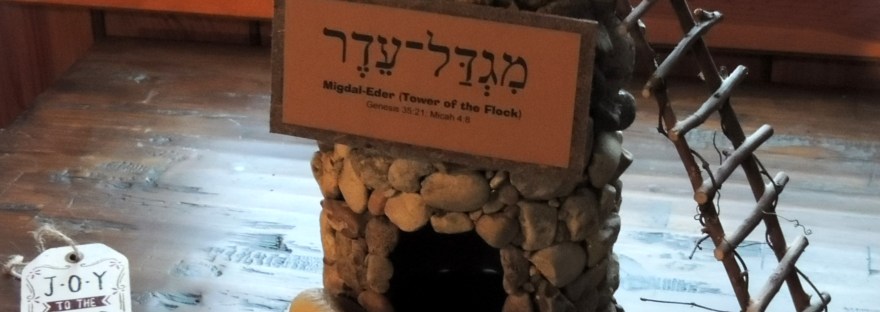
Jacob buried his beloved wife right there where she died, and he set up a headstone for her grave. Do you know that her grave site is still there to this day and marked with a shrine? Jacob then traveled a little further south and pitched his tent “beyond the tower of Eder.” Now, I made that bold for you because God made it bold for me. It literally stood off the page. Even though I’ve read the passage (Gen. 35:21) dozens of times, I never paid attention until this day when God shined His spotlight on it.
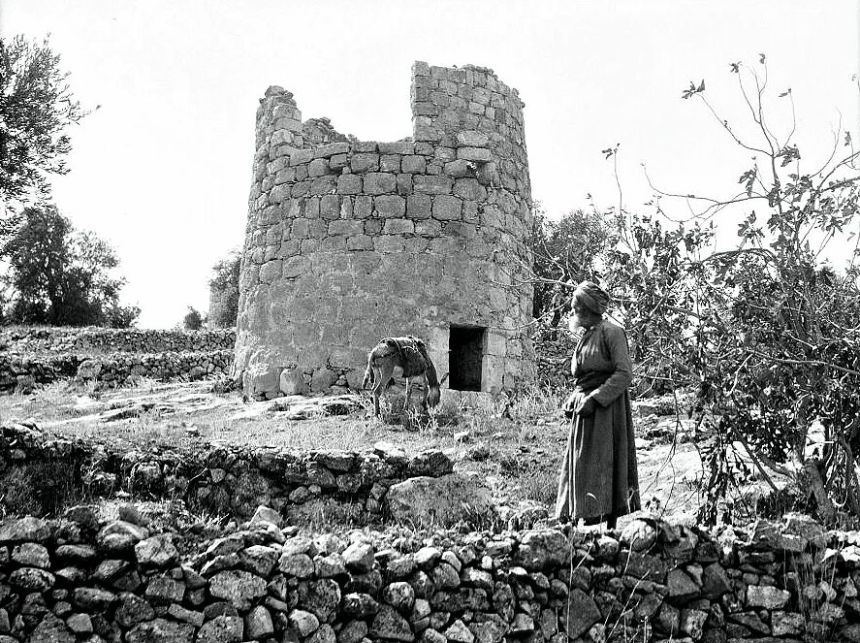
So I looked up “tower of Eder” in my Bible dictionary and found that in the Hebrew language it was called Migdal Eder, which means Tower of the Flock, and it is indeed famous. Oh precious Jesus, my heart is beating so fast. Please help me to write this so that You might be glorified in spite of my fumbling words.
Migdal Eder would one day be the incredibly special place where the most special lambs would be born, the ones without spot or blemish that would be used as the sacrifices for Passover, later, when the temple was built in Jerusalem (according to the Mishnah). You’ll remember that it was Jacob’s son Joseph who was sold into slavery in Egypt and because of a dream was able to provide food for his family, which is why the Israelites went to live in Egypt – and where the Passover observance originated. But getting back to the Levitical temple practices in Jerusalem, my research of various Jewish websites said that these special lambs were watched over by Levitical shepherds (not scruffy, dirty, nomadic nobodies). When the ewes of the flocks started into labor the Levitical shepherds took them inside the ceremonially clean, ground level part of the tower to birth their baby lambs. The lambs were then wrapped tightly in strips of cloth (often old priestly garments) and laid in a manger (which was a stone trough used for water or hay for the animals) to keep them safe until they could be carefully inspected by the priestly shepherds whose lot had fallen to do that. Are you starting to feel something stir in your spirit?

.
Here is a prophecy of the birth of Messiah in Micah 5:2
“But you Bethlehem Ephrathah, though you are little among the thousands of Judah, yet out of you shall come forth to Me the One to be Ruler in Israel, whose goings forth are from of old, from everlasting.” And the prophecy is remembered at the birth of Jesus in Matthew 2:6 “But you, Bethlehem, in the land of Judah, are not the least among the rulers of Judah; for out of you shall come a Ruler who will shepherd My people Israel.”
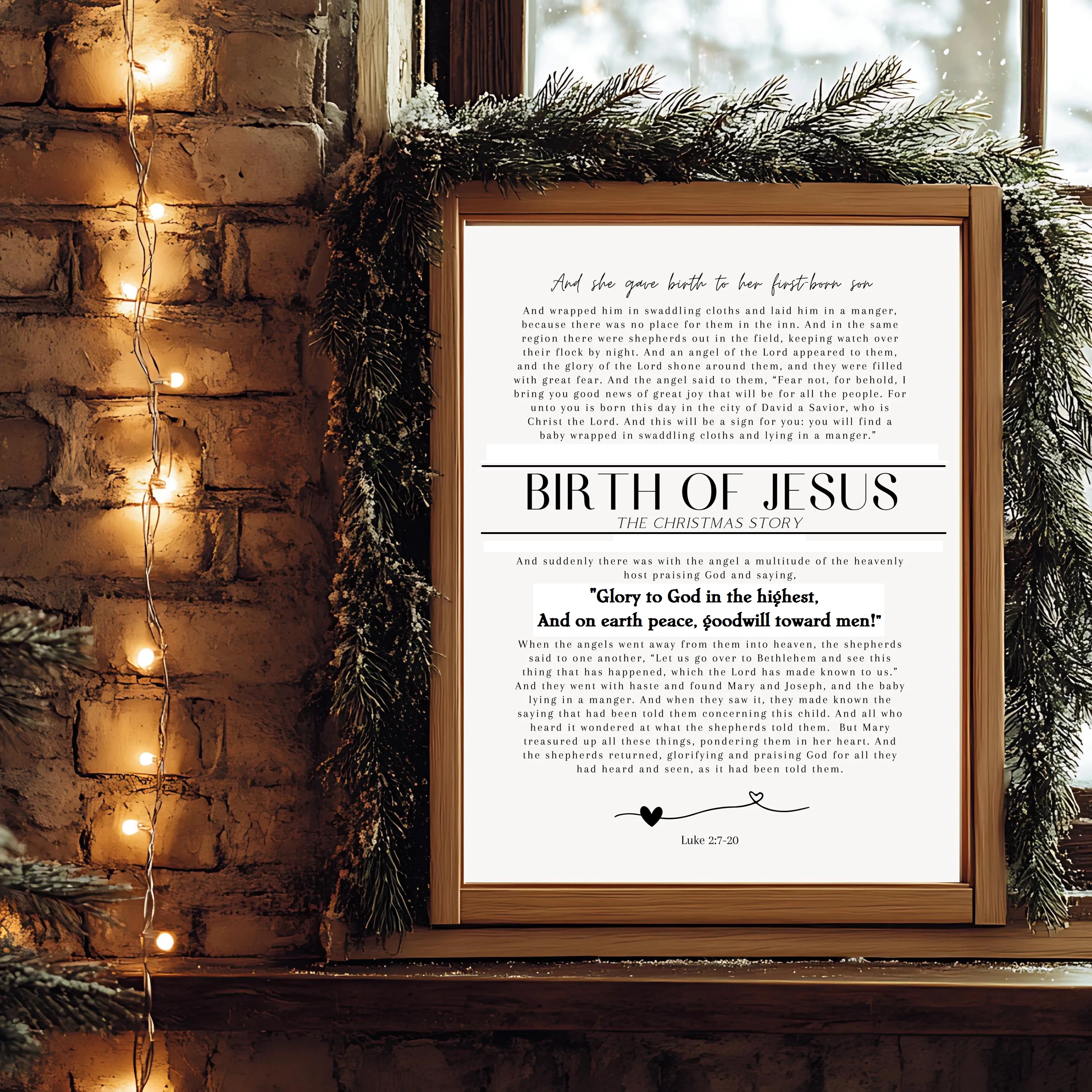
Luke 2:4-7 then also tells us: “Joseph also went up from Galilee out of the city of Nazareth, into Judea to the city of David, which is called Bethlehem, because he was of the house and lineage of David, to be registered with Mary, his betrothed wife, who was with child. So it was, that while they were there, the days were completed for her to be delivered. And she brought forth her firstborn Son, and wrapped Him in swaddling cloths, and laid Him in the manger, because there was no other lodging place for them in Bethlehem”
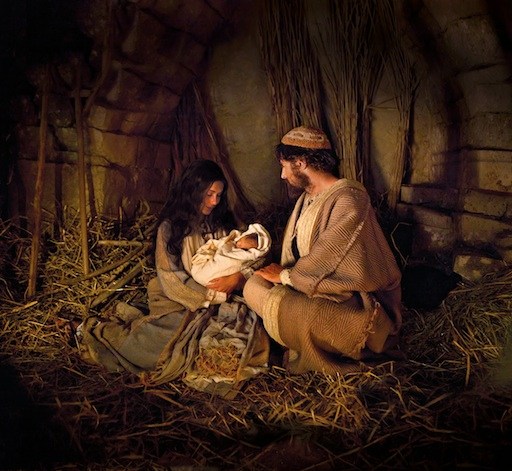
Many Messianic websites suggest that Jesus was born in the watchtower of Eder, not a lowly and dirty stable, as has been portrayed for years, but the very clean, bug free, and very special place where ALL the lambs were born who would become a PASSOVER SACRIFICE in Jerusalem.
.
“And there were shepherds abiding in the fields…” These descendants of Jacob were keeping watch in the fields by night for wolves or other predators that might try to harm their sheep when the angels of God burst on the scene. According to my research the sheep were kept in the Bethlehem hills during the green springtime of the year, during lambing season. Later in the summer they would be moved to the harvested fields where they would eat the stubble and deposit fertilizer for the next crops. They would then be moved to winter in the wilderness, as the law required. These particular shepherds were no doublt familiar with the scriptures of Genesis, Micah, and Isaiah, which said:
“The scepter shall not depart from Judah, nor a lawgiver from between his feet, until Shiloh comes; and to Him shall be the obedience of the people… (from there is the Shepherd, the Stone of Israel), by the God of your father who will help you” Genesis 49:10, 24-25.
The shepherds didn’t run all over Bethlehem looking for this Savior baby, nor did they run all over the hills looking in caves and watch towers. No, they knew exactly where to go look, because of the other prophecy in Micah…
“And you, O tower of the flock, the stronghold of the daughter of Zion, to you shall it come, even the former dominion shall come. The kingdom of the daughter of Jerusalem.” Micah 4:8
.
Bethlehem was near Jerusalem in the the land of Judah, the land of King David, the land of Boaz – the kinsman redeemer (which we read about in the Book of Ruth), Boaz, who grew wheat and let Ruth glean from his crops to feed and make bread for her mother-in-law Naomi…in fact the name Bethlehem means House of Bread – and it just so happens that Jesus refers to himself as the “bread of life” in John 6:35!!!!! Cool stuff. Just so much cool stuff!!!!
Anyway, this Tower of the Flock was right outside of Bethlehem where The Lamb of God, without spot or blemish, the One who would take away the sin of all who would choose Him, was born. But He is not come to us just as the Lamb, but He is also the Good Shepherd (John 10:14; Ezekiel 34:11-31; Psalm 23;) of whom Ezekiel prophesied, whose ministry would be to the lost and scattered sheep of Israel (Matthew 18:10-14; Luke 15:1-7; Luke 19:10). He was born to die as the Passover Lamb (Mark 14:12; John 1:29; John 10:14-16; 1 Corinthians 5:7; 1 Peter 1:19; Hebrews 4:15; Revelation 5:6) who takes away the sin of the world.
“Who has believed our report? And to whom has the arm of the Lord been revealed? For He shall grow up before Him as a tender plant, and as a root out of dry ground… Surely He has borne our griefs and carried our sorrows ; yet we esteemed Him stricken, smitten by God, and afflicted, but He was wounded for our transgressions, He was bruised for our iniquities; the chastisement for our peace was upon Him, and by His stripes we are healed. We all like sheep have gone astray; We have turned, every one, to his own way; And the Lord has laid on Him the iniquity of us all. He was oppressed and He was afflicted…He was led as a lamb to the slaughter…For He was cut off from the land of the living; For the transgressions of My people He was stricken. He has put Him to grief. When You make His soul an offering for sin…by His knowledge My righteous Servant shall justify many, for He shall bear their iniquities…Because He poured out His soul unto death…And He bore the sin of many, and made intercession for the transgressors.” Isaiah 53
Do you remember from reading earlier what Rachel named her son? And what Jacob renamed him? They perhaps didn’t even know it, but those names were also a prophecy of the baby boy who would one day be born there, right there, who would be the Son of His Father’s right hand (Mark 16:19), but the sorrow of His mother (Matthew 2:18 & Jeremiah 31:15; Luke 2:33-35 & John 19:25).
And if that isn’t incredible enough, Rachel’s name even means “Ewe.” (And Mary’s name means bitterness).
Jesus said in Matthew 5:17 “Do not think that I have come to abolish the Law or the Prophets; I have not come to abolish them, but to fulfill them.”
… Behold! The Lamb of God who takes away the sin of the world (John 1:29)!!! Jesus, the Son of David, is our Kinsman Redeemer (our Boaz from Bethlehem who was King David’s great grandpa)! “Has not the Scripture said that the Christ Messiah comes from the seed of David (the king) and from the town of Bethlehem, where David (the shepherd boy) was from?” John 7:42. (John 10; Psalm 23).
Moving on to the Shepherd and …
The SHEEP GATE
Sha’ar – “gate” (of the)
hasso’n – “flock”
One of the gates of Jerusalem rebuilt by Nehemiah (Neh 3:1,32; 12:39) was The Sheep Gate. It was located between the Tower of the hundred (Migdal Meah aka Antonia) and the upper room of the corner (3:1,32) or gate of the guard (12:39). This is most likely the sheep gate mentioned in John 5:2; 10:1-10. Look closely at this map so you can picture the location of the Sheep Gate in your mind as you recall the last events of Jesus’ life. Jesus was in the Garden of Gethsemane, was betrayed, and was arrested, and then was brought to the high priest. If you follow the road from Gethsemane up to the north side of the temple mount you’ll see the Sheep Gate. That is the gate Jesus was brought through, being that it was nighttime and it would be discrete. It is by the way, the same gate where all the sacrificial lambs were brought through at Passover to be inspected by the priests and then sacrificed.
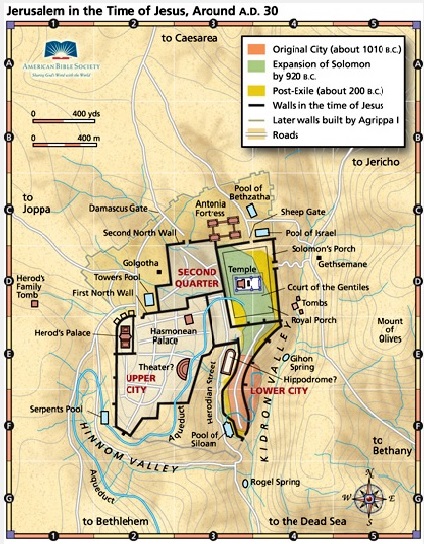
In a book, written by A. W. Pink, a minister of the gospel, p28 of Studies in the Scriptures, published 1926 – 1927, Rev. Pink writes:
“And led Him away to Annas first. The Saviour was neither ‘driven’ nor ‘dragged,’ but led: thereby the Holy Spirit informs us, once more, of His willing submission. He offered no resistance. With infinitely greater ease than Samson of old, could He have burst His bonds ‘as a thread when it toucheth the fire; but as prophecy had announced, ‘He was led as a lamb to the slaughter’ –gentle and tractable. Here also He fulfilled not only prophecy but type: each animal that was to be offered in sacrifice was first led to the priest (Lev. 17:5), so Christ was first brought to Annas. The road followed from the Garden to the house of the high priest was also significant. Gethsemane was at the foot of Olivet, on the east side of Jerusalem, beyond the brook Cedron. In journeying from there to the City, the gate through which they would pass was “the sheep gate:” (Neh. 3:1, 32; 12:39; John 5:2 and see our notes on the last). The “sheep gate” was nigh unto the Temple, and through it the sacrificial animals passed (first having been fed in the meadows adjoining the Cedron [today called the Kidron – the Kidron Valley]; so also went the true Lamb on this occasion! Note a striking contrast here: Adam was driven out of the Garden (Gen. 3:24), Christ was led!”
Isaiah the prophet wrote the words, “he was led as a lamb to the slaughter” (Isaiah 53:7,8), and in the New Testament it was the apostle Philip who explained the passage to an Ethiopian eunuch, whom he met on the road to Gaza, who was reading it, apparently out loud. Philip asked if the man understood what he was reading, and beginning with that scripture, he preached Jesus to him (Acts 8:26-39).
This was Jesus’s own testimony about himself:
“Most assuredly, I say to you, he who does not enter the sheepfold by the door, but climbs up some other way, the same is a thief and a robber. But he who enters by the door is the Shepherd of the sheep. To him the doorkeeper opens, and the sheep hear his voice; and he calls his own sheep by name and leads them out. And when he brings out his own sheep, he goes before them; and the sheep follow him, for they know his voice … I am the door of the sheep…I am the door. If anyone enters by Me, he will be saved, and will go in and out and find pasture. The thief comes to steal, kill, and destroy. I have come that they may have life, and have it more abundantly! “ John 10:1-10 NKJV
Jesus entered the sheepfold of humanity by the same door that we all enter into this life – by the womb of a woman. He entered His ministry after being baptized and confirmed by the Holy Spirit (as a pattern for us to follow) as a symbol of rebirth (John 3:1-17; Mark 16:16; Matthew 28:19-20; Acts 2:24; Romans 6:4-14; Colossians 2:12-13; 1 Peter 3:21). And He became the perfect Passover Lamb in the same way as all the other Passover lambs that ever were, since the institution of the Passover observance. He didn’t climb up some other way. He entered by the door. He is the door. He is the Way. The scriptures told us ahead of time, so that when such things began to pass we would know it was of God.
Now, I don’t mean to put you on the spot or anything, but the point of me sharing these Bible studies is to share the good news with you. Isn’t this good news to know we serve a God who gave His life for us? So, may I ask you a question? Have you made Jesus your Passover Lamb?
It is in the Law of Moses that the Israelite people are to purchase their lamb four days ahead of the Passover (Exodus 12:3-6), and do you wonder why?
I’ll visit the WHY in a moment, but I found a beautiful article that pondered the HOW of keeping a lamb for four days that I’d like to talk about first. The very first families, and those in the wilderness wanderings, would have had to choose their lamb and then bring it into their home to keep it safe. In this way they made it a part of their family, inspected it carefully, fed it, petted it, loved it and got to know it intimately! It was that family’s perfect, spotless lamb and it was cherished because “this lamb wasn’t just giving its life for their food… This lamb was literally saving the life of their firstborn. A direct trade–its life for his. The blood of this lamb told the Angel of Death “Don’t stop here.” It marked that house as belonging to God.
It was supposed to hurt.
It was supposed to be hard to kill that lamb.
It was supposed to cost them something.
It was supposed to make them pause and consider how important this was.” (RosannaMWhite.com)
This reminds me of a dream (vision, maybe) that God gave to me a few years ago. I saw Jesus bound to the whipping post, surrounded by ruthless Roman soldiers. One very muscular soldier, had a cat-of-nine-tails, or scourge, firmly in his grasp. He drew his arm back and the strands of the scourge whipped past his face. His biceps flexed as in one smooth motion he brought his arm forward again, and aiming for Jesus naked body, he launched those hooks at the ends of each tail deeply into the flawless olive skin of Jesus’ back, embedding them like anchors tossed off a ship which borrow into the sea floor. Then, almost as instantly as they had penetrated, the soldier drew his mighty arm back again, and I saw blood and pieces of Jesus flesh go with each strand of that vicious tool. It was too awful to watch. But as the bone fragments reemerged, I saw my name etched on one of them, and simultaneously I heard the Father say, “That one was for your sins” (one of the many sins I’ve committed in my life – because in all honesty, I’ve broken every one of the 10 Commandments, multiple times, if not in the flesh, certainly in my mind). Thirty-nine times that whip defaced Our Perfect Lamb’s immaculate body. Nine tails X 39 stripes is 351 wounds He endured on my behalf, and your behalf. He took the punishment that I deserve. I’ve been a Christian now for 42 years. I’ve brought my Savior home with me and gotten to know Him personally, and intimately. To think that He did that for me when yet I was a sinner. But, if I take His sacrifice lightly and go back to my sinful lifestyle after knowing the debt that was paid, what sacrifice for my sin is left?
This is another explanation for the 4 days from Chabad.org (Ashkenazi Jewish organization):
“The ancient Egyptians worshipped lambs. Taking a lamb, the Egyptians’ deity, into their homes for four days, with the intention of slaughtering and eating it, was an act that was sure to be noticed by the Egyptians. It was extremely likely that they would be infuriated by this disrespect of their god. This act of courage, standing up for their beliefs and following G‑d’s command in the face of possible danger, was a merit for the Jews, one that made them worthy of being redeemed.
Nowadays, for the most part, standing up for our beliefs doesn’t put us in physical danger. But we should still use the example set by our ancestors to inspire us to have courage in living according to our principles.”
Do you have the courage to choose Jesus? Do you have the fortitude to stand for faith in Christ even when everyone around you might not like you for it? Might make fun of you for it?
The thing of it is that if you make Jesus your Ebeneezer – your Stone of Help (1 Sam.7:12), you’ll never walk alone. And the only way to overcome the enemy (Satan), who wants to steal and to kill and to destroy us, is having Jesus as our Savior. Our testimony of coming to faith in Jesus, and staying faithful to Him through every trial, by His shed blood as our Passover Lamb is how we overcome Satan (Revelation 12:11).
So, as the patriarchs did with earthly stones, let us also memorialize Yeshua Jesus in our lives (Dt.6:6-9) as living stones, being built up a spiritual house. Let us be for Him altars of testimony so that when our kids, or our friends, or our neighbors ask, “What is this faith that you have; what is this pile of rocks all about?” we can tell them of all the mighty things the LORD has done for us, knowing that if we should be made silent, even the stones we leave behind will cry out (Luke 19:40)!!!!! Just as the stones of Rachel’s grave and those of the Migdal Eder are surely crying out to us now in Doxology to God! Amen! Bless you so much!
“Knowing that you were not redeemed with corruptible things, like silver or gold, from your aimless conduct received by tradition from your fathers, but with the precious blood of Christ, as of a lamb without blemish and without spot.”
1 Peter 1:19

“Enter by the narrow gate; for wide is the gate and broad is the way that leads to destruction, and there are many who go in by it, but narrow is the gate and difficult is the way which leads to life, and there are few who find it.” Matthew 7:13-14
I have updated my post in December 2022 to share with you several other teachers *with credentials* who have found this passage of scripture and researched it and taught on it, so that you may know by the witness of two or three others that this trustworthy.
A Lamb’s Tale and a Mysterious Tower, by Mini Manna Moments
The Christmas Prophecy of Bethlehem, by Gary Stearman (Prophecy Watchers)
The Secret of the Shepherds, by Christine Darg


 mrshlovesjesus
Thank you for sharing your article. Wonderful how the Lord leads our paths to cross.
LikeLike
Oh thank you sir for your visit and comment. Yes, it is! God bless you! 🙂
LikeLike